




Wednesday, 15 July 2026 01:00 PM
Product Announcements
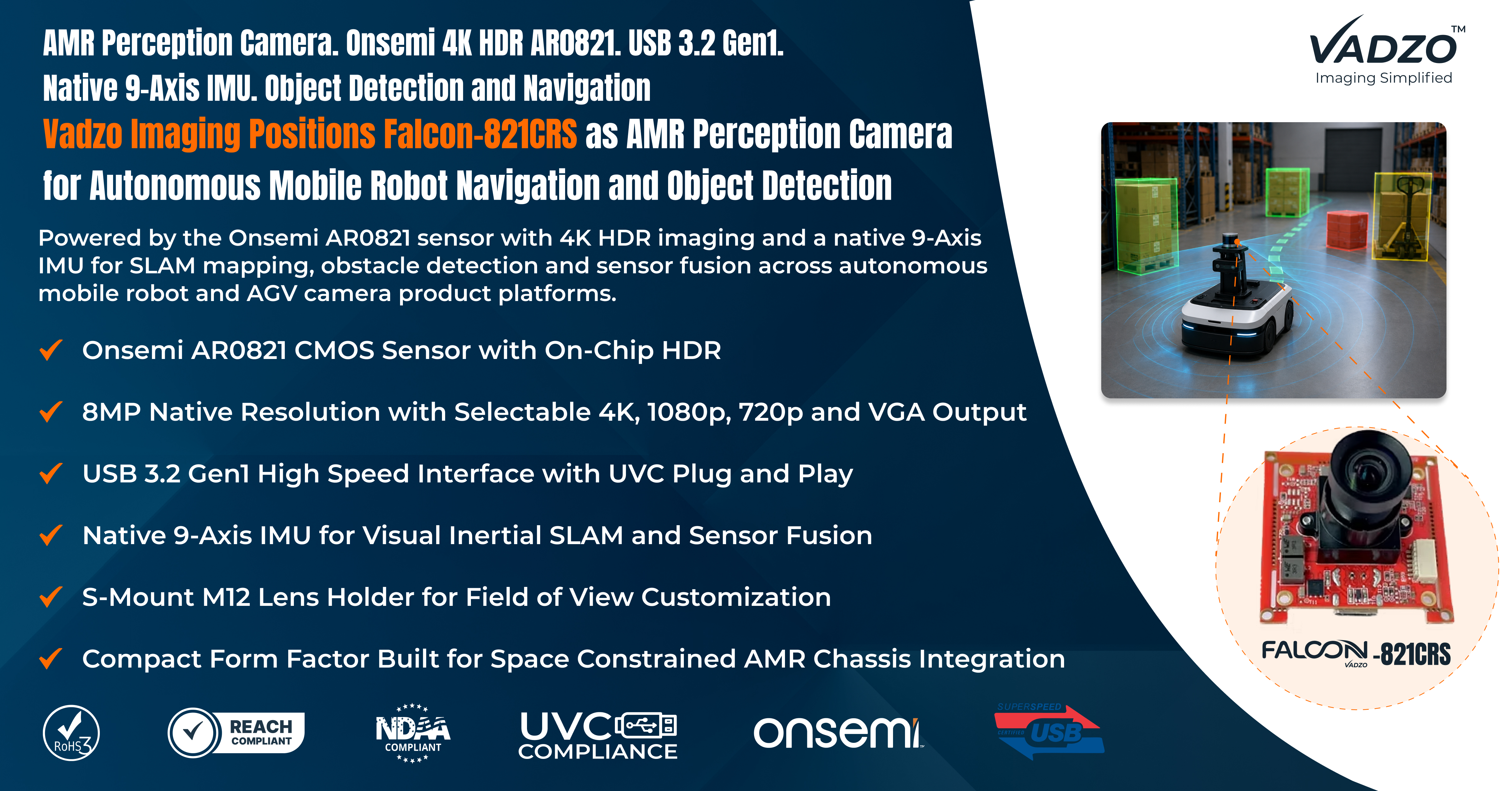
The Falcon-821CRS is a 4K HDR AMR Perception Camera built on the Onsemi AR0821 sensor for autonomous mobile robot platforms. It combines 8MP native resolution with on-chip HDR, a native 9-Axis IMU and USB 3.2 Gen1 connectivity to support real time navigation, obstacle detection and SLAM mapping. It is designed for warehouse AMR fleets, indoor mobile robot fleets, logistics automation and OEM robot camera module integration with driver support for Windows, Linux and Android in a compact S-Mount form factor.
FORT WORTH, TX / ACCESS Newswire / July 15, 2026 / Vadzo Imaging, a provider of embedded vision camera products, today positions the Falcon-821CRS 4K HDR Camera as an AMR Perception Camera built on the Onsemi AR0821 sensor for autonomous mobile robot navigation, mapping, and object detection. The camera combines 8MP native resolution with an on-chip High Dynamic Range with a native 9-Axis IMU and USB 3.2 Gen1 connectivity in a single S-Mount module. This gives robotics engineering teams one qualified part number that addresses navigation object detection and mapping across warehouse and indoor logistics deployments without integrating a separate camera and inertial sensor for each function.
Why AMR Perception Camera Selection Determines Detection Reliability
Indoor autonomous mobile robots operate under lighting conditions that shift continuously across a single shift. A loading dock bay lets in direct sunlight, while the same aisle ten meters inward sits in shadow under overhead fluorescent fixtures. A vision sensor that clips highlights or loses shadow detail across this range hands the perception stacks a frame with missing information, exactly where an obstacle or a floor marker needs to be resolved. This is the core reason system integrators now specify an HDR Robot Vision Camera rather than a standard fixed exposure imager for any AMR program operating across mixed indoor lighting zones. Dynamic range captured at the sensor level, rather than reconstructed through software tone mapping, determines whether the perception stack receives usable pixel data at the aisle entrance and at the aisle midpoint in the same frame.
Frame delivery timing carries equal weight. A robot moving through a warehouse aisle needs image data that reflects its current position closely enough that the navigation stack can react before a detected obstacle enters the collision envelope. A Real Time Robot Camera with full 8MP capture and selectable lower resolution output modes lets engineering teams trade spatial detail for frame rate on the same hardware rather than committing to a single fixed operating point at the design stage. This flexibility avoids a common integration failure where a sensor is chosen for mapping quality first, and the resulting frame rate turns out to be too slow for the reaction time the drive system requires at operating speed.
How On-Chip HDR and Synchronized IMU Data Solve Robot Perception Challenges
Software HDR reconstructs dynamic range after capturing multiple exposures inside the image signal processor or on the host processor. Each merge step and each stage of software correction add processing time to the imaging pipeline. For a low-latency robot camera, the navigation control loop that timing overhead compounds directly into robot response delay. The Onsemi AR0821 sensor instead performs high dynamic range capture at the pixel and column level before the frame leaves the sensor, which removes an entire processing stage from the path between photon capture and the data the perception algorithm actually uses.
Sensor fusion between visual data and inertial data introduces a separate synchronization problem. Most robotics platforms pair a camera with a standalone inertial measurement unit connected through a separate bus and clocked by a separate timer. Aligning those two data streams after the fact requires timestamp interpolation that introduces error into pose estimates. A Robot Visual Perception Camera that embeds the inertial sensor inside the same module and timestamps of IMU samples against the image frame clock removes that interpolation step entirely. This is the engineering rationale behind pairing the Onsemi AR0821 sensor with a native 9-Axis IMU inside the Falcon-821CRS module rather than requiring integrators to source and synchronize a separate inertial sensor.
Sensor and Camera Overview
The Falcon-821CRS is a AR0821 Perception Camera built on the Onsemi AR0821 CMOS sensor and paired with a dedicated image signal processor. The AR0821 is an 8MP (3848 x 2168) color rolling shutter sensor with a 1/1.7-inch optical format and a 2.1 µm pixel that delivers on-chip High Dynamic Range along with low noise output across a wide brightness range. As an Onsemi AR0821 Robot Camera, the sensor gives autonomous mobile robot platforms the dynamic range needed to resolve floor markers, pallets, and personnel across mixed indoor lighting without relying on multi-frame software HDR.
The Falcon-821CRS packages the AR0821 sensor, the image signal processor, a fixed focus S-Mount lens assembly, and a native 9-Axis IMU inside a single compact housing connected to USB 3.2 Gen1. Output resolution is selectable between full 8MP capture, 4K, 1080p, 720p, and VGA, which lets a single 8MP Robot Camera module serve detail mapping passes and lightweight real-time inference from the same hardware. The camera enumerates as a standard UVC device on Windows, Linux, and Android with no proprietary driver installation required.
For simultaneous localization and mapping workloads, the module functions as an AR0821 SLAM Camera, delivering synchronized visual and inertial data over a single USB connection. As an AR0821 AMR Vision Camera, it supports both the perception layer that detects obstacles and the localization layer that tracks robot poses within a shared coordinate frame. Robotics engineering teams building a robot sensor fusion camera pipeline around visual inertial odometry gain a single qualified part number instead of a camera and an inertial sensor sourced and synchronized separately.
Key specs: 8MP (3848 x 2168) | Onsemi AR0821 CMOS | 1/1.7-inch optical format | 2.1 µm pixel | Color Rolling Shutter | On-Chip HDR | Native 9-Axis IMU | USB 3.2 Gen1 | 8MP / 4K / 1080p / 720p / VGA output | S-Mount M12 lens holder | Windows, Linux, Android
Key Capabilities of the Falcon-821CRS AMR Perception Camera
4K HDR Imaging for Reliable Object Detection in Variable Warehouse Lighting: Object detection models trained on well-lit test data frequently fail in production when a pallet or a person crosses from a bright dock door into a shaded rack aisle within the same frame. A 4K Robot Perception Camera with on-chip HDR captures both the highlight and the shadow region in one exposure, so the detection model receives consistent pixel data regardless of where in the frame the object sits. As an HDR AMR camera, the Falcon-821CRS extends this dynamic range advantage to loading docks with direct sun exposure and to interior aisles lit only by overhead fixtures using the same fixed sensor configuration. Selecting the 4K output mode from the native 8MP capture gives a 4K AMR Camera configuration that balances spatial resolution against the bandwidth and processing budget of the onboard computer platform.
Wide Field of View Coverage for Full Aisle and Corridor Awareness: Narrow aisle warehouse environments require a perception sensor that covers the full corridor width at close range without losing the angular resolution needed to classify obstacles near the edge of the frame. The S-Mount M12 lens holder on the Falcon-821CRS lets integrators fit a Wide FOV AMR Camera configuration using a wide-angle optic for tight aisle coverage or swap to a narrower field lens where longer detection range at speed matters more than edge-to-edge coverage. Because the sensor outputs a native 8MP frame, a 4K perception camera configuration retains enough pixel density even after a wide-angle lens spreads the scene across the full frame. This flexibility makes the module a practical Indoor Robot Camera choice across warehouse aisles, retail floors, and hospital corridors where corridor geometry varies by deployment site.
Native 9-Axis IMU for Visual Inertial SLAM and Sensor Fusion: Building an accurate occupancy map or localizing a robot within a previously mapped facility depends on tightly synchronized visual and inertial data. The Falcon-821CRS functions as a SLAM camera module with accelerometer, gyroscope, and magnetometer readings timestamped against every image frame over the same USB 3.2 Gen1 connection. This removes the clock drift and interpolation error that appear when a Robot Mapping Camera and a separate inertial sensor run on independent clocks. For fleets operating inside a fixed facility footprint, the AMR Indoor Navigation Camera with native inertial data supports both the mapping pass that builds the facility model and the ongoing localization that keeps every robot aligned to its true position on that map.
Multi-Resolution Output for Balancing Mapping Detail and Real-Time Inference: A single hardware platform rarely serves both the initial facility mapping pass and the ongoing real-time obstacle detection workload at the same resolution. Full native capture on the 8MP AMR Camera configuration suits-controlled velocity mapping runs where spatial detail outweighs frame rate. Switching the same module to 1080p, 720p, or VGA output gives an Autonomous Robot Camera the frame rate headroom needed for continuous obstacle detection during normal operating speed. Because resolution selection happens through standard UVC controls, a Mobile Robotics Camera fleet can reconfigure output mode in software without swapping hardware between the mapping phase and the production deployment phase of a project.
USB 3.2 Gen1 Plug and Play Integration with Robot Compute Platforms: Robot compute platforms built around NVIDIA Jetson boards or embedded Linux single board computers need imaging hardware that enumerates immediately without a proprietary driver stack to install and maintain. As a USB AMR Camera Module, the Falcon-821CRS connects to any USB 3.2 Gen1 host port and appears immediately as a standard UVC device. Because it is a UVC Robot Camera, it works natively under Linux V4L2, Windows DirectShow, and standard UVC frameworks without a custom kernel module. For engineering teams standardizing a robot compute platform across multiple product lines, a USB Robotics Vision Camera that requires no driver maintenance reduces long-term firmware support burden across the fleet.
Compact S-Mount Form Factor for Space-Constrained AMR Chassis Design: Chassis space on a compact indoor AMR platform is limited, and every sensor mounted on the frame competes for the same enclosure volume as batteries, drive electronics, and safety sensors. The Falcon-821CRS ships in a compact module footprint with an S-Mount M12 lens holder that accepts any standard M12 threaded optic without requiring a redesign of the mounting bracket when the lens changes. This makes it a practical OEM Robot Camera Module for chassis designers who need to finalize enclosure geometry before every application detail is settled. As an Embedded Robotics Camera, the module supports forward-facing, downward-facing, and multi-camera perception arrays on the same compact form factor across an entire AMR product line.
"Robotics customers kept describing the same gap to us. They wanted a single Autonomous Mobile Robot Camera that could handle both the mapping pass and the everyday obstacle detection workload without swapping hardware between the two. The Falcon-821CRS closes that gap. On-chip HDR from the Onsemi AR0821 sensor keeps the perception stack fed with usable pixel data across mixed lighting, and the native 9-Axis IMU gives the localization stack synchronized pose data from the same module. As an AMR Navigation Camera, it lets our robotics customers standardize on one qualified part number across mapping, navigation, and object detection instead of integrating separate camera modules and inertial sensors for each function."- Alwin Vincent, Product Manager, Vadzo Imaging.
Applications
Warehouse AMR Navigation and Obstacle Detection: Warehouse AMR fleets need to detect pallets, racking, and personnel across aisles that shift from bright dock doors to dim interior rows within a single traversal. A Warehouse Robot Camera built on the AR0821 sensor delivers the dynamic range needed to hold detail across that lighting range in one frame. Functioning as an Obstacle Detection Camera, the module feeds a consistent image stream to the perception model regardless of aisle position, and functioning as a Robot Navigation Camera, the synchronized IMU data supports pose estimation for lane following and docking maneuvers.
Indoor Mobile Robot Fleet Operations: Fleets of indoor mobile robots operating across a shared facility need a consistent perception of hardware across every unit so that a model trained on one robot performs the same way on the rest of the fleet. Standardizing on AI Robot Vision Camera with fixed sensor characteristics across every unit removes a variable that otherwise complicates fleet-wide model deployment. As a Fleet Robot Camera, the Falcon-821CRS gives every robot in the deployment the same 8MP native resolution, the same on-chip HDR response, and the same synchronized IMU timing, making it a repeatable AMR Perception Camera choice across a fleet rollout rather than a one-off integration.
Logistics and Distribution Center Automation: Distribution centers running continuous shift operations put perception hardware through extended daily runtime across changing dock lighting and seasonal daylight variation. A Warehouse Automation Camera built for this environment needs a dynamic range that holds up during both the bright midday dock shift and the artificially lit overnight shift. As a logistics robot camera, the Falcon-821CRS supports automated guided cart and AMR fleets moving inventory between receiving, staging, and outbound zones. Functioning as a Dynamic Obstacle Detection Camera, the module tracks forklifts, pedestrians, and shifting pallet load that a static floor plan cannot anticipate.
Collaborative Mobile Robots in Manufacturing: Collaborative mobile robots sharing floor space with production personnel on a manufacturing line need reliable object detection with a margin for human safety. An Industrial Robot Vision Camera that resolves detail consistently under mixed factory lighting supports the perception layer that a safety-rated stop system depends on. As an Autonomous Navigation Camera, the Falcon-821CRS supports both fixed routes following work cells and dynamic rerouting around temporary obstructions using the same synchronized visual and inertial data. Manufacturing engineering teams are evaluating a AMR Perception Camera for a collaborative robot program to gain a single qualified part for both functions.
OEM Robot Camera Module Integration for Custom AMR Platforms: OEM robot manufacturers building a custom AMR chassis often need to integrate a perception camera into an enclosure design that was finalized before every application detail was known. Vadzo Imaging supports OEM integration of the AR0821 Robot Perception Camera with lens selection assistance, cable length customization, and firmware configuration support so that manufacturers can finalize enclosure geometry early in the program without locking in every imaging parameter at the same stage.
Frequently Asked Questions
Q: What does a perception camera do inside a mobile robot?
A: A perception camera captures the visual data that a mobile robot uses to detect obstacles, read floor markers, and understand the layout of the space around it. Inside the navigation stack, this visual data is combined with inertial and wheel odometry data to build a picture of where the robot is and what stands in its path. Vadzo Imaging designs its camera modules so that this visual data arrives already synchronized with inertial sensor data over a single connection, which is a meaningful simplification for the robotics engineering teams that build the navigation software on top of it. This hardware-level synchronization drastically reduces motion blur artifacts in visual-inertial odometry (VIO) and ensures that time-to-collision calculations are based on tightly coupled data streams, ultimately delivering more reliable state estimation in dynamic environments where the robot must react instantly to moving pedestrians or forklifts.
Q: Can one camera handle both mapping and everyday obstacle detection?
A: Yes, when the camera supports selectable output resolution from the same sensor. A single module can run at full native resolution during a controlled mapping pass and then switch to a lower resolution output for everyday obstacle detection, where frame rate matters more than pixel count. Vadzo Imaging builds its robotics camera modules with this selectable output specifically so that OEM customers do not need separate hardware for the mapping phase and the production phase of a robot program. This flexibility also conserves system bandwidth and reduces processing load during routine operation, freeing up the robot's main compute unit for other critical tasks like path planning, while still retaining the ability to capture rich, high-fidelity detail whenever a new map or site re-calibration is required-all without swapping physical lenses or sensors.
Q: Why does dynamic range matter for a robot moving between light and shadow?
A: A camera with limited dynamic range either loses shadow detail or clips bright highlights when a scene contains both dark and bright regions in the same frame, which is common whenever a robot moves from a sunlit dock area into a shaded aisle. High dynamic range captured at the sensor level keeps both regions visible in a single exposure, so the detection software receives complete information rather than a partially blank frame. Vadzo Imaging selects sensors with an on-chip high dynamic range specifically to solve this problem for indoor and mixed lighting robotics deployments. By preserving detail in both extreme highlights and deep shadows, these sensors ensure that feature-detection algorithms-such as ArUco marker reading, barcode decoding, or edge-based obstacle detection-remain functional under glaring sunlight or inside dark storage bays. This is a crucial requirement for automated guided vehicles (AGVs) operating in warehouses with skylights, bay doors, and overlapping artificial lighting, where exposure conditions can change in milliseconds.
Q: What is the advantage of a built-in inertial sensor in a robot camera?
A: A built-in inertial sensor removes the need to source a separate module and synchronizes its clock with the camera, which is a common source of integration delay and poses estimation error. When the inertial data is timestamped against the same clock as the image frame, the navigation software receives cleanly aligned data without additional calibration work. Vadzo Imaging includes a native inertial sensor inside select camera modules for exactly this reason and proudly supports the robotics teams that rely on this synchronized data for simultaneous localization and mapping. This tight integration minimizes pose drift during high-speed rotations or brief occlusions (such as passing between tightly packed racks), as the inertial data provides high-frequency motion updates that fill the gap between successive camera frames. The result is tighter loop closures, more consistent trajectory tracking over long operating runs, and a significant reduction in the tedious hand-calibration steps that traditionally plague multi-sensor fusion projects.
Q: Does Vadzo Imaging help OEM customers customize a robot camera module?
A: Yes. Vadzo Imaging works directly with OEM robot manufacturers on lens selection, cable length, firmware configuration, and mounting geometry so that a camera module fits a specific chassis design rather than forcing the chassis around a fixed part. This engineering support is available from early prototype units through volume production and is one of the reasons robotics customers return to Vadzo Imaging for each new platform they bring to market. Beyond mechanical and optical tailoring, Vadzo's team also assists with rigorous system-level validation, including vibration testing, thermal cycling, and shock resistance assessments, to ensure the module maintains its factory calibration and image quality under the real-world stresses of continual floor operation. This comprehensive approach, from initial concept review to final production ramp, gives OEMs confidence in a drop-in-ready vision solution that shortens their overall development timeline.
Availability
The Falcon-821CRS AMR Perception Camera, built on the Onsemi AR0821 sensor, is available now for evaluation and volume orders. Each evaluation kit includes the camera module, a factory-calibrated S-Mount lens, a USB 3.2 Gen1 cable, and a platform driver for documentation with no minimum order requirement. Robotics engineering teams can buy a 4K USB 3.0 HDR USB Camera with AR0821 Sensor Online or contact Vadzo Imaging at [email protected] to request an evaluation kit or discuss OEM integration requirements.
About Vadzo Imaging
Vadzo Imaging is a global provider of embedded vision solutions and delivers high-performance camera technologies and imaging platforms for applications in robotics, industrial automation, UAVs, edge AI, and medical systems. Its camera products are designed for seamless integration with leading embedded platforms. Vadzo Imaging supports customers through hardware customization, firmware development, and module-level drivers that accelerate the development and deployment of vision-based robot and machine perception systems.
Media Contact
Alwin Vincent
Vadzo Imaging
Email: [email protected]
LinkedIn: Vadzo Imaging
YouTube: Vadzo Imaging
X: Vadzo Imaging
SOURCE: Vadzo Imaging